
How VerifyMedCodes.ai is Guarding the Clinical Data Safety and Optimization Gate
Guarding the Gate is One Thing...
Streamlining, and Being Undeniable and Defensible is the Other.
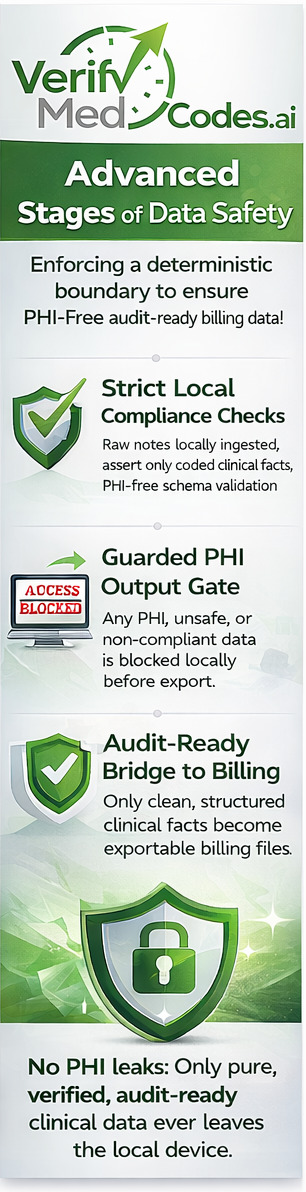
When it comes to a world in which we're leveraging Ai to eliminate all the stress and denials related to optimizing and streamlining successful medical billing, VerifyMedCodes.ai cracked the code with its proprietary approach to creating fully optimized SOAP Notes, and transmitting 100% semantically correct, PHI-Free and de-identified data all the way from dictation into audit ready uploadable billing files.
VerifyMedcodes.ai is a deterministic clinical compiler that transforms raw clinical documentation into a validated, PHI-free clinical knowledge graph - while enforcing a hard safety boundary that prevents any unsafe or non-compliant data from ever leaving the local environment.
Unlike systems that attempt to interpret or summarize clinical notes using probabilistic models, VerifyMedCodes treats clinical documentation as source code, not prose. The system does not clean, redact, or rewrite text, and it does not rely on large language models to “understand” clinical meaning. Instead, it compiles clinical notes using a rule-driven, deterministic pipeline that extracts only what is explicitly documented and clinically defensible.
The compiler ingests raw notes locally—whether structured EHR exports or unstructured dictated text—and converts them into a set of typed, coded clinical facts drawn from controlled medical vocabularies such as ICD-10, SNOMED CT, LOINC, and RxNorm. Each extracted fact is assigned an explicit assertion state (present, denied, historical, possible, etc.), ensuring clinical context is preserved without interpretation or inference.
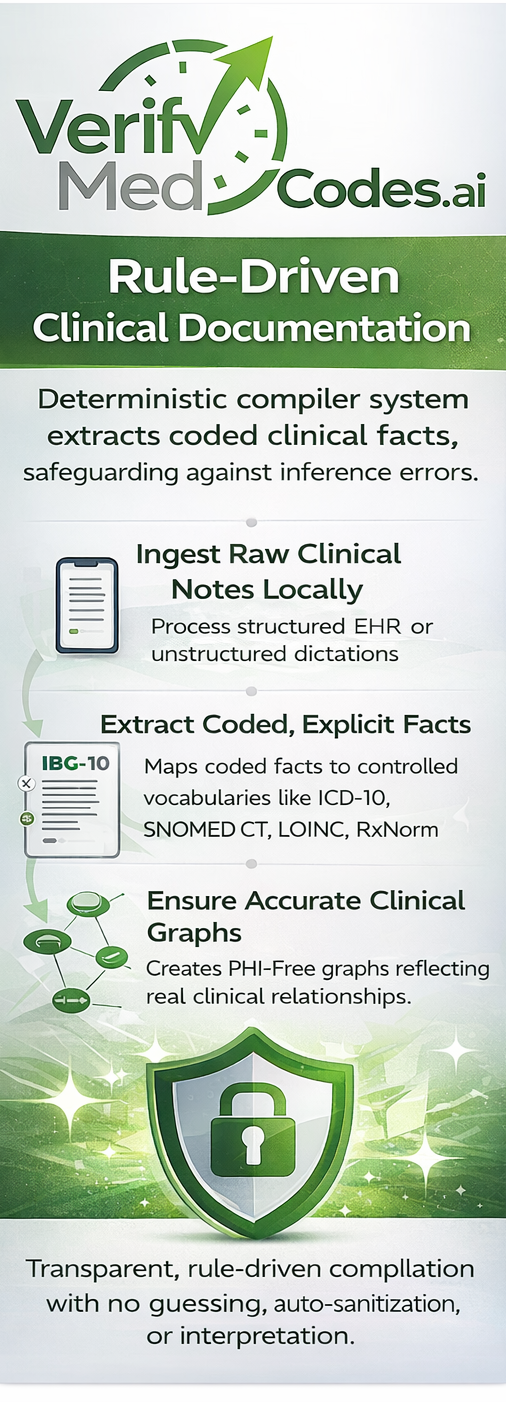
From these facts, VerifyMedCodes constructs a clinical relationship graph that reflects how providers actually document care—linking problems to diagnostic workups, treatments, ruled-out conditions, and management decisions—using only explicit textual evidence. Cross-sentence relationships are formed conservatively and only when the documentation structure or discourse signals make the relationship unambiguous. If the system cannot prove a relationship deterministically, it does not create one.
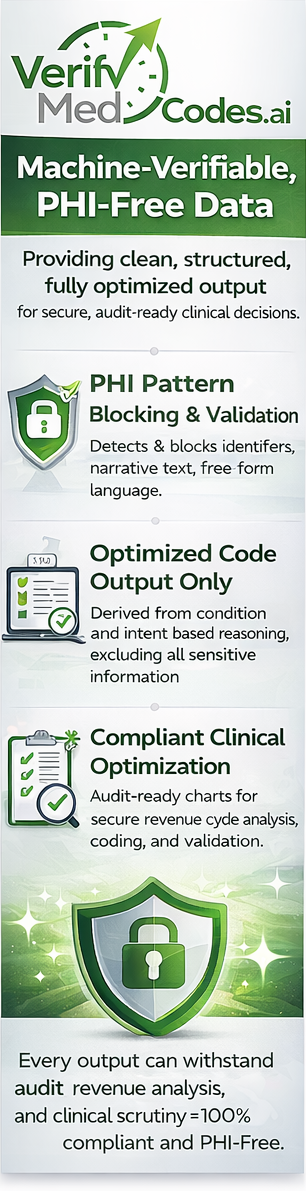
Crucially, VerifyMedCodes enforces a hard PHI output gate. Before any compiled data can be exported or used downstream, it must pass strict schema validation, vocabulary enforcement, and pattern-based PHI detection. Narrative text, identifiers, dates, names, and free-form language are categorically disallowed. Any violation results in the payload being blocked locally. There is no “best effort” sanitization—only pass or fail.
The result is not a summary, recommendation, or rewritten note. The result is a machine-verifiable, audit-ready, PHI-free clinical intermediate representation that can be safely used for downstream reasoning, revenue cycle analysis, quality validation, coding optimization, compliance checks, and AI-assisted workflows—without exposing protected health information or relying on opaque inference.
In effect, VerifyMedCodes functions as clinical infrastructure, not an AI assistant. It creates a clean separation between clinical meaning extraction (local, deterministic, PHI-containing) and downstream reasoning or automation (cloud-safe, PHI-free). This architectural boundary is what allows healthcare organizations to adopt advanced automation while remaining compliant, explainable, and auditable.
VerifyMedCodes is intentionally conservative by design. Across a 200-note, 20-specialty validation run, the compiler executed deterministically with zero failures, producing structured clinical graphs while explicitly refusing to create relationships when documentation was ambiguous or incomplete. Only 30% of notes met the strict structural criteria required for cross-sentence linking, and only 10% produced such links—demonstrating that the system prioritizes clinical defensibility over coverage. Every extracted fact, every relationship, and every refusal to act is traceable to a deterministic rule. Before any compiled data can leave the device, it must pass a hard PHI and schema validation gate. If the output fails validation, the system does not guess or auto-sanitize; instead, it returns a precise, local diagnostic identifying the specific sentences and rules involved, allowing the user to correct the documentation and recompile safely. The result is not higher automation at any cost, but automation that can withstand audit, compliance review, and clinical scrutiny while keeping humans in control.
Everyone in healthcare wants AI, but not everything is allowed to leave. One of the biggest challenges is that the mess starts at the clinic, yet the clinic is typically averse to any types of changes.
How do we change everything without changing anything? That's another ingredient in the VerifyMedCodes.ai recipe.
Life is good behind the VerifyMedCodes gate.
Especially if you are a Revenue Cycle Management high volume billing organization, please challenge us to achieve what most of the best AI companies out there think is unachievable.